Lane splitting and filtering for motorcycles—passing by riding between lanes or sharing (splitting) a lane with other traffic—has been legal in Minnesota since July 2025. The lane-splitting law is pretty simple:
In Minnesota, motorcyclists can split lanes if traffic is moving 25 mph or slower.
But not in:
- Roundabouts/traffic circles
- School zones
- Single-lane work zones
- Highway on-ramps
Regular traffic rules also apply. For example, you can’t use the shoulder or a bike lane to pass. Minn. Stat. § 169.18, Subd. 4(4). So does common sense. Don’t split lanes if there isn’t enough space. And since it comes up every time lane splitting does: motorcyclists who split lanes going faster than 25 mph are breaking the law.
Lane splitting v. lane filtering
Lane splitting and filtering both refer to motorcycles passing cars and other traffic by riding between lanes or within the same lane as traffic. The statute does not actually contain the terms lane splitting and lane filtering, but here is the difference, according to the Minnesota Department of Public Safety:
- Lane splitting is passing moving cars
- Lane filtering is passing stopped cars (i.e., at a stoplight or in a traffic jam)
To save pixels, I’ll use lane splitting for both.
Why Minnesota legalized lane splitting
MPR News reported that the point of lane splitting is to allow motorcycles to move out of danger zones when it is safe to do so, and to reduce congestion.
The measures were passed to improve safety for motorcyclists.
…
In 2022, Phil Stalboerger was traveling on a motorcycle in stop-and-go traffic on I-694 when he was rear ended by a distracted driver. His wife, who was sitting in back, broke several bones.
“This bill is about safety, and it is about reducing congestion,” Stalboerger testified to the Minnesota Senate transportation committee in April 2024.
Lane splitting increases safety and reduces congestion by moving motorcyles out of the main flow of traffic. That means motorcycles are less likely to get squished between cars in stop-and-go traffic, and it means fewer vehicles for cars to deal with.
What the lane splitting law says
The lane splitting rules are in Minn. Stat. § 169.974, Subd. 5(f)–(h).
(f) Except under the conditions specified in paragraph (g), no person may operate a motorcycle:
(1) between lanes of moving or stationary vehicles headed in the same direction of travel;
(2) abreast of moving or stationary vehicles within the same traffic lane; or
(3) to overtake or pass another vehicle within the same traffic lane.
This is stated as a prohibition, but it says you can ride a motorcycle between two lanes of traffic headed in the same direction or ride next to or pass a car within the same lane under the following conditions:
(g) A person may operate a motorcycle and overtake and pass another vehicle in the same direction of travel and within the same traffic lane if the motorcycle is operated:
(1) at not more than 25 miles per hour; and
(2) no more than 15 miles per hour over the speed of traffic in the relevant traffic lanes.
Lane splitting to pass is only legal when the motorcycle is going 25 mph or slower and no more than 15 mph faster than surrounding traffic. So if traffic is stopped, you can’t ride faster than 15 mph. If traffic is moving faster than 25 mph, you can’t split lanes.
(h) For the purposes of paragraph (g), traffic lane does not include:
(1) the approach, drive-through, or exit of a roundabout;
(2) a school zone established under section 169.14, subdivision 5a;
(3) a work zone where only a single travel lane is available for use; or
(4) an on-ramp to a freeway or expressway with or without an active control device where moving or stationary vehicles are queued in one or more traffic lanes.
Paragraph (h) lists four places lane splitting is not allowed:
- Roundabouts/traffic circles
- School zones
- Single-lane work zones
- Highway on-ramps
Also, cars are not allowed to block motorcycles splitting lanes legally:
An operator of a motor vehicle must not intentionally impede or attempt to prevent the operation of a motorcycle when the motorcycle is operated under the conditions specified in section 169.974, subdivision 5, paragraph (g).
The rules are pretty straightforward, but the Minnesota Department of Public Safety gets them slightly wrong on its website.
What the MN DPS website gets wrong (and why it probably makes sense most of the time)
The MN Department of Public Safety has a summary the law on its website. It says lane splitting and filtering are “allowed when two or more lanes of traffic are traveling in the same direction …” and includes these graphics:
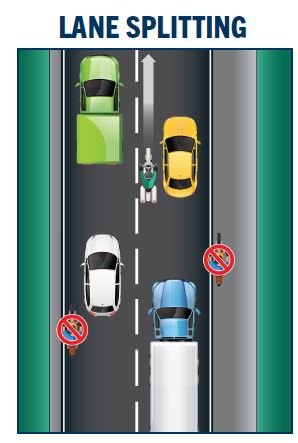
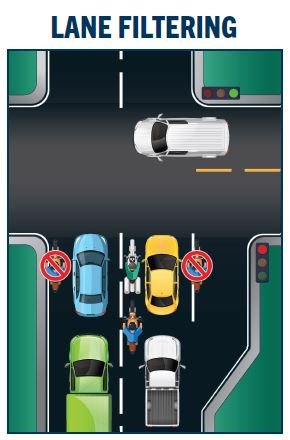
That’s not what the law says.
Paragraphs (f)(2) and (f)(3) say it’s legal to split or filter by riding within the same lane as traffic. That means the leftmost riders in both graphics with the 🚫 over them are actually legal.
I contacted Minnesota Motorcycle Coordinator Jay Bock, who said I wasn’t the first to point out the discrepancy. It sounds like the MN DPS website reflects an earlier version of the law or a revision that’s in the works. Still, it’s not an accurate statement of the current law.
Even so, there are at least a few reasons why it might be a bad idea to split a single lane of traffic:
- It’s risky to split lanes on both sides of traffic as shown in the graphics above. If a car moves over to make room on one side, it’s likely to block or collide with a motorcycle trying to pass on the other side.
- Most lanes aren’t wide enough for a motorcycle to pass a car without leaving the lane and ending up on the shoulder or in an oncoming traffic lane.
- Splitting turns lanes is especially risky.
But there are roads with wide lanes and plenty of room to pass a car on a motorcycle without leaving the lane. As far as I can tell, if you find yourself stuck in traffic on such a road, the law allows you to split lanes if you can do it safely.